For many businesses, planting trees has become almost synonymous with sustainability. A campaign generates carbon, trees are planted, and the business can highlight that activity when discussing its environmental commitments.
It is easy to see why the idea is popular. Planting a tree is tangible. You can see it, photograph it, and explain it in one sentence. It also represents something positive for the future. With time and the right conditions, a small sapling can become part of a larger ecosystem that provides habitat, stores carbon, and supports biodiversity.
But another part of the environmental conversation businesses should pay more attention to is protecting existing ecosystems. While planting new trees is important, protecting the forests, grasslands, and wetlands we already have can deliver immediate and lasting benefits.
Forests, wetlands, grasslands, and other ecosystems already do these things today. They store carbon, support wildlife, and provide habitats now. Protecting them means preventing the loss of what already exists, rather than waiting for something planted today to develop into an established ecosystem.
That distinction is especially relevant when considering the environmental impact of business activity. If a company runs a direct mail campaign or distributes thousands of leaflets this year, it is reasonable to ask what can be done about that campaign's impact now, rather than focusing only on benefits that may come years later.
Planting a tree is not the same as protecting a forest
This is not an argument against planting trees. New woodland plays an important role in nature recovery, provided it is planted in appropriate locations and managed properly.
The issue is that a newly planted sapling does not immediately provide everything that an established forest provides.c
A mature forest is a remarkably complex ecosystem. Trees grow alongside other plants, fungi, and microorganisms. Birds, mammals, and insects use it as habitat. The soil contains an established network of organisms and nutrients. Carbon is already stored in the vegetation and soil, and the ecosystem has developed its own relationships over many years.
Creating a new woodland can eventually provide some of these benefits, but it takes time. The trees have to survive and mature, and the wider ecosystem needs time to develop around them.
Protecting an existing forest is therefore a very different environmental action. You are not starting from the beginning. You are helping ensure that an ecosystem that already provides environmental value remains standing.
World Land Trust describes this principle as an important part of its climate-action approach, with its Carbon Balanced programme supporting the protection and restoration of threatened forest ecosystems. The organisation specifically highlights the importance of safeguarding established forests and grasslands alongside regenerating degraded habitats.
For businesses considering the environmental contribution of their marketing, that distinction matters.
Are you building sustainability into the campaign, or adding it afterwards?
Sustainability often becomes something discussed separately from the business activity that creates the environmental impact.
A company may run a large leaflet distribution campaign, for example, and then look for an environmental initiative that can sit alongside it. The campaign happens on one side, and the sustainability story happens on the other.
There is an opportunity to bring those two things much closer together.
If a business prints and distributes marketing material, it can consider the environmental impact from the start. This includes how the campaign is targeted, the materials used, the production process, and how emissions are managed.
This is where carbon-balanced print becomes relevant.
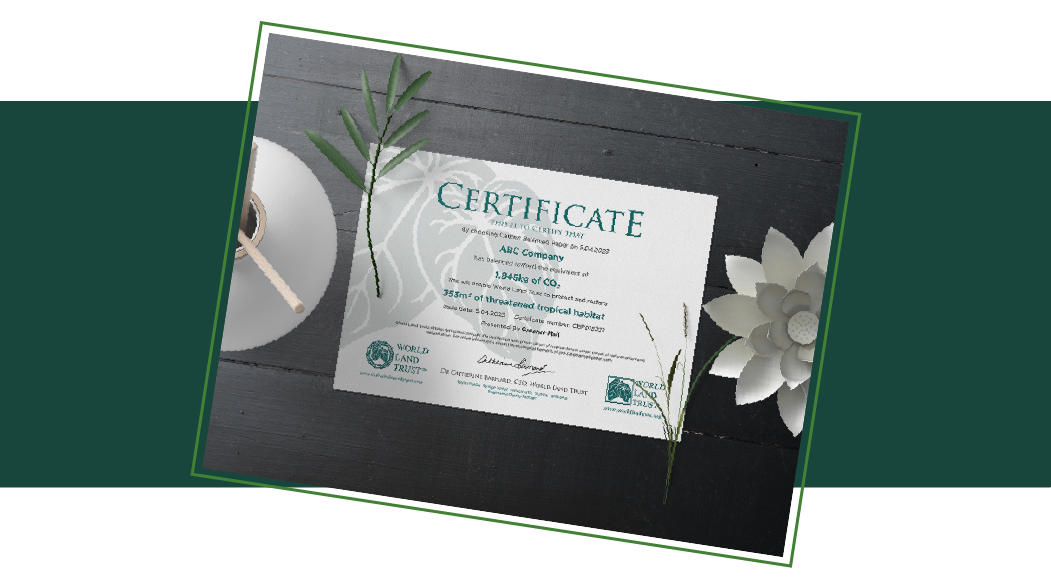
Greener Mail provides carbon-balanced print alongside leaflet distribution, direct mail, and fulfilment. Campaigns can be supported by World Land Trust certification showing the CO₂ balanced and the area of threatened tropical habitat protected and restored. To get started, businesses can contact Greener Mail for a consultation to discuss their next campaign and learn which carbon-balanced services suit them. Marketers can also request information about certification and how to link their campaign’s environmental contribution directly to World Land Trust projects.
For a business, that creates a much more specific sustainability story than simply saying that its latest campaign was "eco-friendly".
You can explain what was done, where the environmental contribution went, and what was achieved as a result.
That level of detail is becoming increasingly important.
Sustainability claims need to mean something
The language businesses use around sustainability is changing.
Terms like "green", "eco friendly", and "sustainable" are everywhere, but the more they are used, the less useful they become when not properly explained.
The Competition and Markets Authority's Green Claims Code makes clear that environmental claims should be truthful and accurate, should not hide important information and should be supported by evidence. Businesses are also expected to consider the wider life cycle of the product or service when making environmental claims.
For businesses investing in sustainability, this is actually a positive development.
It means that the conversation can move away from vague statements and towards evidence.
Rather than just telling a customer a campaign was sustainable, a business can explain the steps taken to reduce and address its environmental impact. It can provide information about the supporting programme and, where applicable, certification.
That is especially useful in B2B marketing, where procurement teams, commercial directors, ESG teams, or customers may consider sustainability claims and want to understand exactly what a supplier means when it describes something as environmentally responsible.
Protecting what already exists deserves more attention
Greener Mail's approach is simple. If environmental action is tied to a printed marketing campaign, why limit it to planting something that might become valuable later?
Protecting established ecosystems has enormous value.
A standing forest is not simply a collection of trees waiting to become useful. It is a functioning ecosystem. It already provides habitat, stores carbon, and preserves biodiversity.
When you protect threatened habitat, you protect those existing benefits.
This does not make restoration or new tree planting unimportant. In many places, restoring degraded land and creating new woodland is necessary. But environmental action does not have to be a choice between planting and doing nothing.
The stronger approach is to recognise that nature needs both protection and restoration.
We need to prevent existing ecosystems from being lost while also rebuilding ecosystems that have already been damaged.
What does this mean for direct mail and leaflet distribution?
For a business, the practical question is how to apply this thinking to everyday marketing.
Direct mail and leaflet distribution remain useful channels for businesses that need to reach specific audiences, particularly when campaigns are carefully targeted. Greener Mail's model combines demographic targeting with design, carbon-balanced print, fulfilment, and distribution, so environmental aspects can be built into the campaign rather than treated as an unrelated activity afterwards.
That doesn't mean pretending printed marketing has no environmental footprint. It does have one.
A more responsible approach is to acknowledge that footprint and consider what you can do about it.
Good targeting helps avoid unnecessary distribution. Mindful design makes print more useful and reduces wasted communication. Choosing an appropriate print process is part of the environmental decision. Carbon balancing then addresses remaining emissions through a recognised programme.
None of those decisions makes a campaign impact-free. They show that the campaign's environmental consequences have been considered rather than overlooked.
For businesses trying to show authentic sustainability, that distinction matters.
A sustainability story that can be demonstrated
Imagine explaining your next marketing campaign to a customer.
You could say you chose a more environmentally responsible approach to your print and that the associated emissions were carbon balanced through a recognised conservation programme.
You could then show them the certification from that programme and explain that the contribution supported the protection and restoration of threatened habitat.
That is a very different conversation from simply saying that you planted a certain number of trees.
It gives the customer something specific to grasp.
It also gives the business something tangible to use within its wider sustainability communications, provided the claims are presented accurately and within the scope of what the certification actually demonstrates.
That last part is important. The CMA's guidance makes clear that businesses should not use a specific environmental benefit to suggest that an entire product, service, or organisation has no environmental impact. Claims need to be clear about what they actually relate to.
For businesses, that means being honest about the whole picture.
A carbon-balanced campaign is still a printed campaign. The value comes from handling its impact responsibly and being transparent about what has been done.
We should not wait to protect nature
There is a natural tendency to think of environmental projects as future-focused.
We plant a tree today because it will be valuable tomorrow. We restore a habitat because it will recover. We make changes now because future generations will benefit.
All of that thinking is important. But another question is just as relevant. What can we protect today?
The answer is not always another sapling. Sometimes it is an existing forest. Sometimes it is a threatened habitat. Sometimes it is an ecosystem already supporting species and storing carbon, but one that could disappear without protection.
World Land Trust's Carbon Balanced programme is built around this combination of protection and restoration, supporting projects that protect and restore threatened forest ecosystems while helping organisations address unavoidable emissions.
For a business, that offers a way to connect an activity happening today with environmental protection happening today.
A different way to think about your next campaign
The environmental conversation around marketing does not need to be about stopping print altogether.
For many businesses, the more useful question is how to produce and distribute print more responsibly.
That starts with choosing the right audience and avoiding unnecessary waste. Carefully targeting direct mail can reduce excess printing and distribution. It also means considering materials and production: marketers might choose FSC-certified paper or recycled stock and work with printers using vegetable-based inks. Understanding the campaign's impact means considering energy use in production and transportation emissions. Choosing credible environmental initiatives is another key step. Partnering with verified conservation projects like World Land Trust or choosing carbon offset programmes with detailed certification helps ensure sustainability claims are specific and evidence-backed.
This is where Greener Mail's approach is different.
The company brings together targeted leaflet distribution, direct mail, print, and fulfilment with carbon-balanced services and World Land Trust certification. After a campaign, businesses receive information showing the amount of CO₂ balanced and the area of threatened tropical habitat protected and restored through the programme.
That gives businesses something much more useful than a generic sustainability statement.
It gives them a story they can back up.
And perhaps that is where the conversation around tree planting needs to develop.
Planting trees has an important role in creating and restoring ecosystems for the future. But protecting the ecosystems that are already here is equally important, particularly when those ecosystems are under threat.
If your business is running a campaign today, it is worth thinking about what that campaign can help protect today.
Not because planting trees doesn't matter, but because the natural world we still have is worth protecting before we have to rebuild what's been lost.
Greener Mail helps businesses make their leaflet distribution and direct mail campaigns more environmentally responsible through carbon-balanced print and support for threatened habitat protection and restoration. While Greener Mail works closely with World Land Trust, other credible environmental programmes and certifications are also available. Marketers should compare options to find initiatives that are transparent, well verified, and aligned with their sustainability objectives.
Author
Rita Kybaite
Published on:
July 8, 2026
Bio
This is some text inside of a div block.
Frequently Asked Questions
1. Is planting trees enough to make a marketing campaign sustainable?
2. Why is protecting existing forests important?
3. What is carbon balanced print?
4. Can leaflet distribution really be environmentally responsible?
5. How can a business demonstrate the environmental contribution of its direct mail campaign?